
Kabaddi: From the Village Court to the Global Market
कबड्डी आज दो समानांतर ढाँचों में चलती है: एक पारंपरिक, ग्रामीण, अनौपचारिक आधार, और दूसरा 2014 में शुरू हुई प्रो कबड्डी लीग के नेतृत्व में बना व्यावसायिक, प्रसारण-केंद्रित मॉडल। बोनस लाइन, डू-ऑर-डाई रेड और सुपर टैकल जैसे नियम मूल रूप से टेलीविज़न के लिए खेल को अधिक स्कोर-प्रधान बनाने के उद्देश्य से जोड़े गए। अंतरराष्ट्रीय स्तर पर एशियाई खेल, विश्व कप और महाद्वीपीय चैंपियनशिप मुख्य मंच हैं, जहाँ भारत की प्रमुख चुनौती ईरान से आती है। खेल की संरचनात्मक कमज़ोरियाँ तीन हैं: भारत में प्रतिभा का कुछ राज्यों में संकेंद्रण, महिला वर्ग में संसाधनों की असमानता, और संघों में प्रशासनिक अस्थिरता। लीग ने खिलाड़ियों की आय और दृश्यता बढ़ाई, लेकिन घरेलू और अंतरराष्ट्रीय प्रदर्शन के मापदंड अलग हैं।
There are two ways to understand kabaddi, and they are usually confused with each other. The first is the game played in an empty field or a school ground on a summer evening — no mat, no fixed dimensions, often no referee, where the rules are settled by local agreement and disputes are resolved on the spot. The second is the game that returns to television every year as a branded product with franchise owners, a player auction, commentators, graphics packages and a fixed broadcast window. The sport is identical; its economy, its audience and its governance are not. Almost every argument about kabaddi — selection controversies, funding, calendar disputes — emerges from the friction between these two worlds.
The structure of the sport is genuinely unusual. A raider has thirty seconds to cross into the opposition half, touch at least one defender or force a tackle, and return — all while holding a single breath and chanting 'kabaddi-kabaddi' continuously. That breath-holding condition is the sport's identity and also its most important technical constraint. It caps the duration of a raid artificially and shifts the decisive variable from endurance to decision speed. Defenders, meanwhile, have a repertoire of formations and the full use of the boundary line as a weapon. The bonus line, the do-or-die raid, the super raid, the super tackle and the all-out were all added later with a clear purpose: to make the sport more predictable and more score-driven for television.
This is where any explanation of kabaddi's current popularity has to begin. Traditional kabaddi produced low scores and long, grinding contests; for a viewer it was often difficult to tell who was ahead. The added rules turned each raid into a small, measurable event that could be converted immediately into points and rendered visually. It is no coincidence that kabaddi's commercial success rests so heavily on its broadcast format rather than on the depth of its competitive structure alone.
Organizationally, kabaddi operates across multiple layers. Internationally, the International Kabaddi Federation governs the rules and the international calendar; continentally, an Asian confederation; nationally in India, the Amateur Kabaddi Federation of India and its state units, with separate structures for the women's game. This multi-layered arrangement has a structural weakness: when administrative disputes erupt inside national federations, the consequences land directly on player selection and international participation. Indian kabaddi has passed through several cycles of litigation and appointed administrators, each of which disrupted national camps and competition calendars.
The Pro Kabaddi League, launched in 2026, is the single largest structural intervention in the sport's history. It changed three things at once. First, the scale of player income — an auction route gave athletes who had been waiting for a government job the option of treating the sport as a full-time profession. Second, the geography of the game — the franchise model tied teams to cities and pushed visibility beyond South Asia. Third, presentation — kabaddi became a television show with slow-motion replays, statistical overlays and player-centred narratives, much like any major cricket league.
The league also reshaped playing style. Traditional matches were defence-heavy and low-scoring; the league format rewarded risk-taking, because bonus points and super raids put a premium on aggression. This produced a new kind of specialist: the pure raider and the pure defender, whose value can be measured cleanly in league conditions. In the traditional structure, a single player had to cover both roles.
The league also opened a route for foreign players, and the clearest example is the flow from Iran, where defenders such as Fazel Atrachali became among the most recognizable figures in the competition. Among Indian raiders, Pardeep Narwal was for years the centre of the league's statistical story, while at national-team level Anup Kumar and Ajay Thakur represented an entire generation. It is worth keeping in mind that league numbers and international performance are different measures — success in the league does not translate automatically into success for the national side.
At the international level, kabaddi rests on three pillars: the Asian Games, the World Cup and continental championships. Since kabaddi was formally included in the Asian Games, that competition has become the focal point of an India–Iran rivalry. India dominated the event for a long stretch, but Iran has established itself in recent cycles as a side capable of beating India. Iran's rise is not merely the story of one team — it demonstrates that kabaddi technique is not confined to any single country's cultural inheritance and can be taught and learned.
On geographic expansion, kabaddi's record is mixed. In Bangladesh, Nepal, Sri Lanka and Pakistan the sport has a natural local base. In countries such as South Korea, Thailand, Malaysia, Indonesia and Kenya, that base is constructed — built through administrative effort, training camps and support from the international federation rather than through organic popularity. This raises a legitimate question: is kabaddi's globalization durable, or is it largely another name for the expansion of the Indian television market?
Women's kabaddi is the fastest-growing and least-resourced part of this picture. The inclusion of the women's event at the Asian Games gave national teams a formal target, but inequality persists in domestic structures: grounds, coaches, physios and the number of matches are all lower at every level than in the men's game. The expansion of the league has created a visibility pathway for women players, but it has not yet become a solid full-time career option.
Another structural fact is the sport's narrow geographic base. In India, kabaddi talent comes mainly from a handful of states — Haryana, Uttar Pradesh, Maharashtra, Tamil Nadu and to some degree Punjab and Odisha. This concentration cuts both ways. On one hand, the rural playing tradition in these states created a stable talent pool without which the league could not have been built. On the other, it means a large share of potential talent elsewhere in the country is systematically excluded. The scouting structure is largely informal and often depends on former players' personal networks.
At the governance level, three issues recur. First, administrative instability within federations and its direct effect on selection. Second, credibility and transparency — information on sponsorships, broadcast rights and player contracts remains limited in public. Third, integrity — anti-doping surveillance in kabaddi has been narrower in scope and lower in testing volume than in other popular sports, a concern for a game that depends on strength and endurance.
The summary is this: kabaddi today sits on an unstable balance between its traditional base and its commercial format. The league gave the sport money, visibility and professional status; it also changed the rules so the sport would suit broadcast. The question is not whether that change was good or bad — it has already happened. The real question is whether a durable foundation can be built underneath the commercial structure: organized competition at school and college level, geographically diverse scouting, equal resourcing for the women's game, and federations that appear in the news for their calendars rather than their disputes. Without those, kabaddi will remain a market rather than a sport.
The next real test will likely come from outside the sport: the broadcast rights market, competition for viewer attention, and competitive balance internationally. As long as teams such as Iran keep challenging India, the sport will retain the tension that draws audiences. But if international competition narrows to two countries, kabaddi's claim to being global will remain a claim on paper.
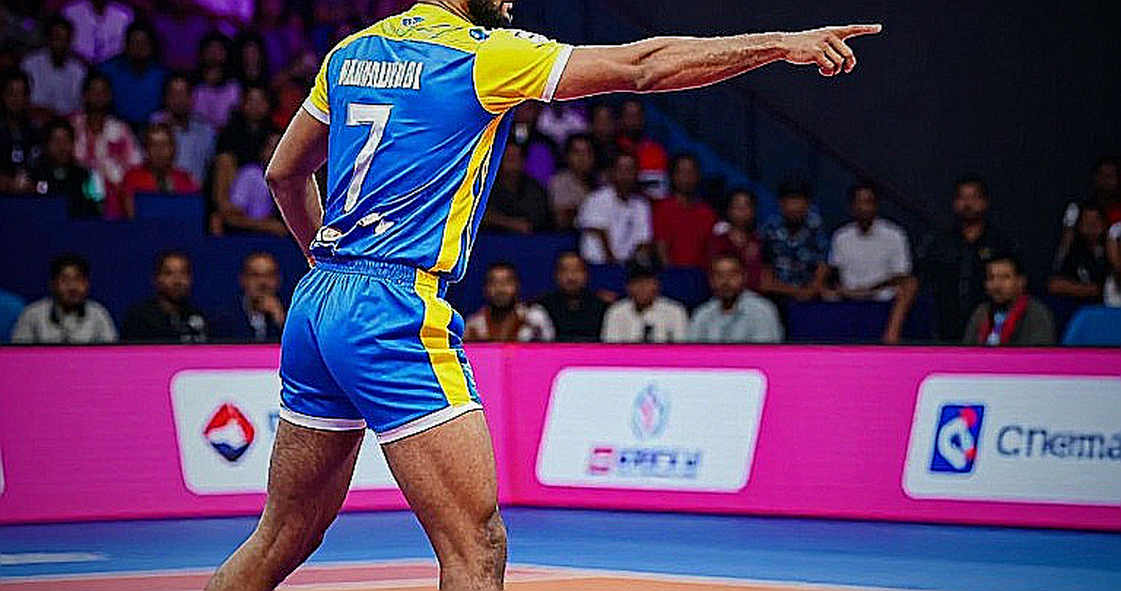

संबंधित खिलाड़ी
अनुशंसित
Commonwealth Kabaddi Championship 2026: India in Rhythm, Big Win Over Nigeria Expected, but the 'Real Test' Question Remains2026-10-27
Commonwealth Kabaddi: India open against Malaysia and England in Ahmedabad, the nine-day load is the real test2026-10-30
Commonwealth Kabaddi Championship 2026: India's Rhythm Shows, but Iran's Absence Leaves a Question Mark2026-10-26
From 18-27 to 33-29: India's kabaddi gold was returned by selection, not by sentiment2026-10-31
Captain First, Squad Later: The Real Question Buried Inside Surjeet Singh's Captaincy and Naveen Kumar's Vice-Captaincy2026-10-30
The 500th Raid Point Notebook: Kabaddi's Scoreboard Measures Volume, Not Capability2026-10-29
Commonwealth Kabaddi Championship 2026: Nine Days, 13 Nations, and an Empty 'List of All Teams'2026-10-23
अनुशंसित
Commonwealth Kabaddi Championship 2026: Nine Days, 13 Nations, and an Empty 'List of All Teams'2026-10-23
India vs England, Commonwealth Kabaddi Championship 2026: The Real Match Is a Rotation Audit, Not the Scoreline2026-10-30
India's First Match in Ahmedabad, but the Biggest Question in the Notebook Isn't England2026-10-24
The PKL market trades in raider names; the table is built on left covers2026-11-01
Surjeet Singh Named India Captain, Naveen Kumar His Deputy: The Blanks India's Kabaddi Team Must Fill Before Ahmedabad2026-10-23
Commonwealth Kabaddi Championship 2026: India in Rhythm, Big Win Over Nigeria Expected, but the 'Real Test' Question Remains2026-10-27
India vs England, Match 4: The Ahmedabad Mat Where the Scoreline Will Explain Nothing2026-10-24