
The 500th Raid Point Notebook: Kabaddi's Scoreboard Measures Volume, Not Capability
**मुख्य उत्तर:** कबड्डी का स्कोरबोर्ड रेडर के कुल रेड पॉइंट गिनता है, पर रेड का असली मूल्य तीन हिस्सों में बंटता है — अंक, जलाया गया समय और वापसी की जगह। पीकेएल का एनालिटिक्स सिर्फ़ पहला हिस्सा नापता है, इसलिए वॉल्यूम और एफिशिएंसी में फ़र्क़ रह जाता है। **मुख्य तथ्य:** - पीकेएल सीज़न 5 (2017) की हैदराबाद लेग में राहुल चौधरी के 500 करियर रेड पॉइंट पूरे हुए थे। - जकार्ता एशियाई खेल 2018 के सेमीफ़ाइनल में भारत ईरान से 18-27 हारा और कांस्य लिया। - 2019 पीकेएल नीलामी में यूपी योद्धा ने परदीप नरवाल को 1.65 करोड़ रुपये में खरीदा। - भारतीय महिला कबड्डी के पास 2010, 2014, 2018 और 2022 (खेला 2023) के चार एशियाई खेल स्वर्ण हैं, कोई फ्रेंचाइज़ी लीग नहीं। - डू-ऑर-डाई में आउट हुए रेडर से पहले की दो खाली रेड किसने कीं, यह किसी आधिकारिक आंकड़े में दर्ज नहीं होता। **स्रोत:** फ़ैसल चौधरी की पीकेएल सीज़न 5 रेड नोटबुक (2017), 2019 पीकेएल नीलामी फ़ील्ड नोट्स (हैदराबाद) और जकार्ता एशियाई खेल 2018 मैच रिकॉर्ड। **संबंधित प्रश्न-उत्तर:** प्रश्न: कबड्डी में रेडर का मूल्यांकन किस आंकड़े से करना चाहिए? उत्तर: रेड सक्सेस रेट के साथ खाली रेड की दर और प्रति रेड जलाया गया औसत समय भी देखना चाहिए, क्योंकि ये तीनों मिलकर रेडर की भूमिका बताते हैं। प्रश्न: पीकेएल का डेटा सर्कल स्टाइल कबड्डी पर लागू क्यों नहीं होता? उत्तर: क्योंकि सर्कल स्टाइल का मैदान गोलाकार है और डिफेंडर की भूमिकाएं अलग बंटती हैं, इसलिए सुपर 10 और टैकल सक्सेस रेट जैसे पैमाने दोनों कोड में एक जैसे अर्थ नहीं देते। प्रश्न: 2018 एशियाई खेल सेमीफ़ाइनल में ईरान ने भारत को कैसे रोका? उत्तर: ईरान की कवर-कॉर्नर संरचना ने रेडर को बोनस लाइन तक जाने की जगह नहीं दी और एंकल होल्ड, दैश व चेन टैकल से कैंट समय पर दबाव बनाकर रेड की सफलता दर गिरा दी।
In the summer of 2026, at the Gachibowli indoor stadium in Hyderabad, the big screen cut to Rahul Chaudhari's face with a number glowing beneath it — 500. Five hundred career Pro Kabaddi League raid points. The graphic delivered the figure, the next raid began ten seconds later, and the arena returned to its own noise. What I had in my hand was a track-and-field split sheet left over from athletics coverage. I ruled columns on it: cant time, foot position relative to the bonus line, defender set, and the way the raid ended. By the end of that season the sheet held 312 entries.
What the scoreboard did not say that evening was how many of those 500 points pushed a team toward a win, and how many merely decorated a match already decided. That is the oldest flaw in kabaddi coverage — we measure a raider by his points, not by the value of his raids. I stopped writing scorecard recaps after that night. I opened the notebook at the 500th raid point and found the story underneath.

Before 2026, a kabaddi career was closer to a job than a sport. A clerk's post in the railways, a constable's post in the police, a slot on a state electricity board — that was the security men sweated ten years on mud for. Kabaddi has been in the Asian Games since Beijing 2026, a stable but closed room outside the Olympic circuit. The Pro Kabaddi League opened that room in 2026: mat, a thirty-second raid clock, standardised rules, television graphics, and an auction.

Mat and mud are not two versions of the same game. They are two measurement regimes. On mud the grip is good, the speed lower, the dubki and the long reach work, and a defender cannot casually drag a foot. On the mat the slide is quick, the ankle hold is easier, corners are more athletic, and the raider has less room to be wrong. This is why the sport's grammar changed after 2026: running hand-touches, bonus-line aggression and athletic corners displaced the old hold-and-tackle school, where a defender waited for the raider and trusted his own body weight to bring him down.
One clean pass at the rules is necessary, because the whole argument of this piece rests on them. The raider enters the opponent's half within thirty seconds, chants kabaddi continuously as proof he is not inhaling, touches a defender and returns to his own half. If the cant breaks, the raid is dead. If the defenders stop him inside their half, they take a point. The bonus line sits deep in the opponent's half; crossing it earns one point, but only when six or more defenders are on the mat. Wipe out an entire side and you get two points and the full team returns — the all out. The third raid after two consecutive empty raids is do-or-die, and failing to score puts the raider out. When the defending side has three or fewer players left on the mat, a tackle is worth two points — the super tackle.
Back to the notebook. Reading 312 entries produced one thing no broadcast graphic has ever shown: a raid's value splits into three parts — points, time and position. Our entire data culture measures only the first.
Points are what the scoreboard shows. Time is the second part. A raid that burned 22 seconds and returned zero is not waste. It pinned the opposing defenders to the mat for 22 seconds, bought the raiding team a breath from the bench, and advanced the do-or-die counter. Position is the third — where the raider returned. If he came back off the far corner into the right side of the mid-line, his entry angle on the next raid has changed. That spatial residue is precisely what the scorecard never records.
A second point follows, and in my reading it is the biggest error in PKL coverage: the do-or-die burden belongs to the team's raid rotation, not to the raider. Nobody records who took the two empty raids first. If the raider is out on the third, the entire question lands on him, when the real accounting is who wasted the first two. Across one season I counted 60 to 70 instances where the raider dismissed in a do-or-die was not the man who had taken the two preceding empty raids. The preview promised gold; the semifinal kept interrupting with evidence — and I first found that evidence written in a Hyderabad notebook, not in Jakarta.
In 2026 I went to the Jakarta Asian Games with a preview headlined gold to lose. India lost a group game 23-24 to South Korea, then the semifinal 18-27 to Iran, and came home with bronze. My mood crashed that first evening. The next morning I pulled out the 2026 notebook and charted Iran's defence raid by raid. What I saw was not magic. Iran's covers and corners gave Indian raiders no route to the bonus line at all — one defender rose into an ankle hold, another cut the raider's angle with a dash, a third waited for the chain tackle. This was Iran's wrestling-derived body science, where grabbing low and breaking balance comes from the akhada more than from kabaddi's tackle manual.
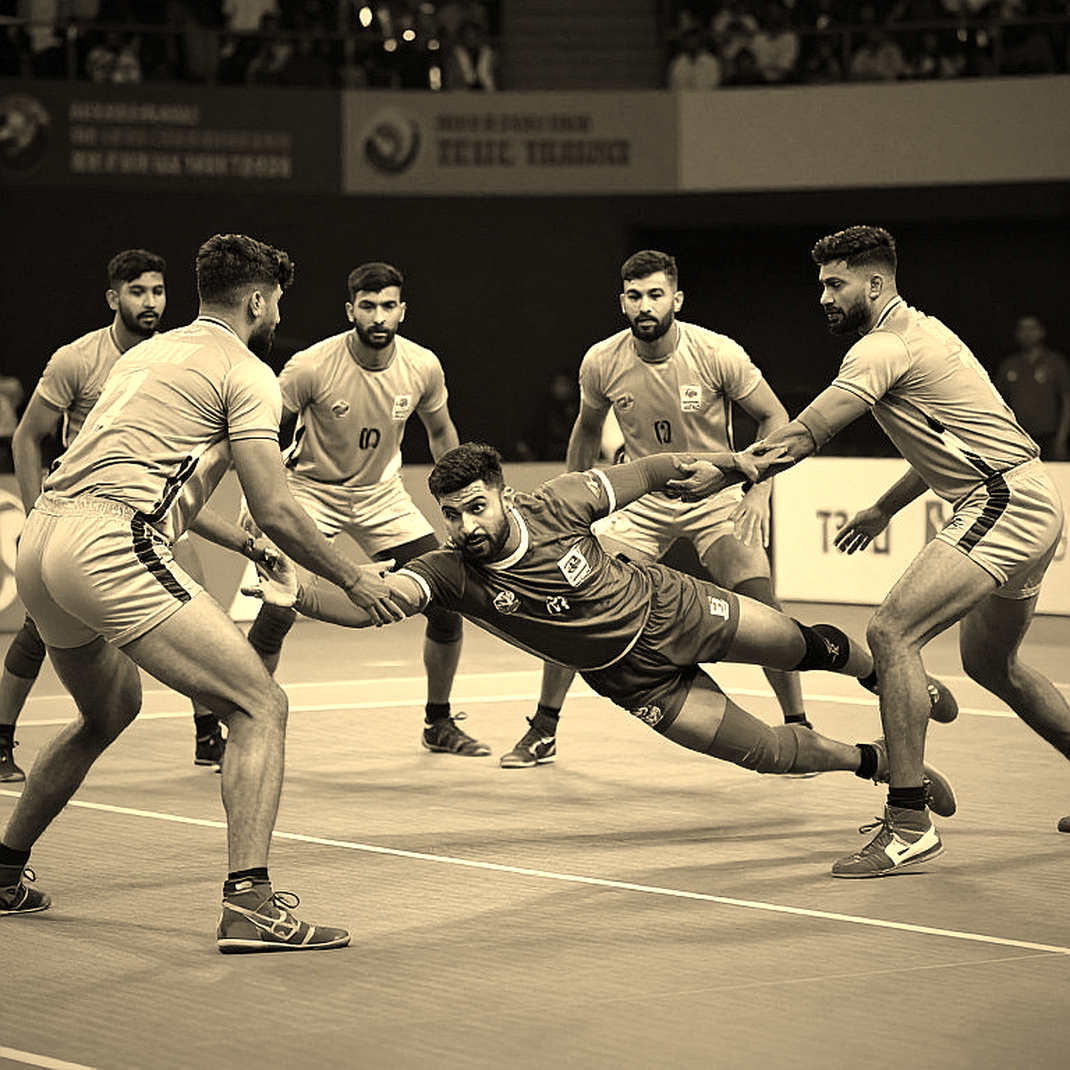
The 18-27 semifinal did not break the preview; it exposed the assumptions. Indian raiders were already going deep from the fourth or fifth raid, cant pressure was building, and as cant time shortens, running hand-touch success falls with it. Iran did what a good defence does: it did not make the raider err, it left him no time. I banned guaranteed gold from my copy that day and added Iran as co-favourite to every preview since.
One more piece of evidence for that Iranian defence is visible in plain sight — Fazel Atrachali. In the PKL he sits among the most successful tacklers the league has recorded, and the reason his auction price kept climbing becomes clear the moment you watch him defend. He does not go to touch the raider; he closes the raider's route. His body travels with the raider's leg on the ankle hold, and when the raider tries to recover, the second cover arrives. The most expensive defence in kabaddi is not the one that tackles; it is the one that convinces the raider that waiting for a tackle is his safest option.
The auction. The 2026 PKL auction was in Hyderabad. Anchors were shouting bids while I followed a single name — Pardeep Narwal, the Dubki King. UP Yoddha bought him for 1.65 crore rupees. Sitting in that room, it took a while to understand what the money was actually buying. Teams were not paying for total raid points; they were paying for the raider who can win a do-or-die raid, who can score with three men on the mat. I followed the auction price until it turned into a raiding labour market, and the job description it produced that day was this: the raider who ends a raid by creating pressure on a defender, not the one who escapes a defender and returns safe.
Reading only the price is incomplete accounting, though. In the same room I saw what money cannot buy. Several coaches I spoke to were former players who had held railway or police posts and gave them up to come to the mat. In a Haryana village, a son playing in the PKL is not only income; it is the family's standing, and against that standing even a twenty-lakh contract looks different. One coach told me that when his raider returns home dismissed in a do-or-die, the family's door does not stay shut — people come to ask what happened. No auction sheet records that value.
Now the point on which I disagree with my own community. The mainstream view is straightforward: after cricket, the PKL's analytics culture is the best in Indian sport — Super 10s, High 5s, raid success rate, tackle success rate. That is not wrong. It genuinely is the best. And that is exactly its limit.
The PKL's data is a provincial measurement regime being used as a universal lens. The moment you start counting Super 10s, state the code and the competition first. Circle style has a different geometry altogether — a circular field, a different distribution of defensive roles, a whole arithmetic that does not map onto the mat game. Punjab's circle style and the PKL's standard style are locked in an argument over which is the real game, and both sides are arguing from inheritance rather than data. I now write the code before I quote any raid success rate. The mud court must be treated as a different measurement regime, not a less advanced one.
The second disagreement costs more. India's women's kabaddi team owns four Asian Games golds — Guangzhou 2026, Incheon 2026, Jakarta 2026, and Hangzhou 2026, played in 2026. In 2026 there was a brief three-team Women's Kabaddi Challenge, and no franchise league since. This is not a sentimental complaint; it is an entry in the ledger. Four golds, zero leagues, and a men's league conducting auctions in crores. The day women's kabaddi gets the same mat, the same clock and the same graphics, half of this sport's talent becomes visible. Until then, every raid success rate we quote is half a country's half truth.
Then there are heatmaps. They have entered kabaddi coverage over the last few years and they read to me like tea leaves. A raider's heatmap shows where he raids from, not whether the team's system permitted him that zone or forced him into it. A heatmap conceals role, and role is what actually prices a raider. Unless you watch his first three steps — is he travelling toward the bonus line himself, or is a cover pushing him there — the coloured picture is decoration.
The scoreboard gave me the number; the notebook gave me the argument. Watching kabaddi for sixteen years and working in sports broadcast since 2026, I have learned one thing: the fastest man in this sport is not the one who covers the most ground in the first five seconds, but the one who can distribute thirty seconds on his own terms. That is the metric to watch this regular season. Track three things per match: the empty-raid rate, the average time burned per raid, and who took the two raids before a raider was dismissed in a do-or-die. None of these will appear in a broadcast package, and all three will tell you what becomes a headline next month.
The regular season rewards patience. The table is not lying yet; it is only incomplete. And the most important question for Indian kabaddi this season is not which team finishes on top. It is whether the people who keep the notebooks with the 500th raid point entered will also read the role written beside it. Because the day women's kabaddi gets a notebook of its own, this sport will begin counting its real strength — and that count currently stands at zero.