
होमKabaddiCommonwealth Kabaddi Championship 2026: India's Rhythm Shows, but Iran's Absence Leaves a Question Mark
Commonwealth Kabaddi Championship 2026: India's Rhythm Shows, but Iran's Absence Leaves a Question Mark
यह एक मूल हिंदी खेल समाचार रिपोर्ट है जो कॉमनवेल्थ कबड्डी चैंपियनशिप 2026 में भारत की तीन जीतों और नाइजीरिया के खिलाफ चौथे दिन के मुकाबले पर केंद्रित है। रिपोर्ट बताती है कि भारत ने इंग्लैंड को 46-26, युगांडा को 44-30 और मलेशिया को 37-23 से हराया। मुख्य विश्लेषण यह है कि भारत की तीन जीतें ईरान की गैरमौजूदगी के कारण वैश्विक दबदबे का पूरा प्रमाण नहीं हैं, क्योंकि ईरान कॉमनवेल्थ सदस्य नहीं है। टूर्नामेंट में इंग्लैंड, तंजानिया, मलेशिया, युगांडा और नाइजीरिया शामिल हैं। नाइजीरिया को इंग्लैंड से 68-18 और तंजानिया से 66-17 की हार मिली, जिससे टीमों का तीन-स्तरीय ढांचा स्पष्ट होता है। भारत की सबसे मजबूत रक्षात्मक पहल इंग्लैंड के खिलाफ दिखी, जिसने नाइजीरिया के खिलाफ 68 अंक बनाए लेकिन भारत के खिलाफ सिर्फ 26। हालांकि भारत ने प्रति मैच 23-30 अंक दिए, जो रक्षा में ढीलापन दिखाता है। कप्तान सुरजीत सिंह एकमात्र नामित खिलाड़ी हैं, लेकिन उनकी भूमिका स्पष्ट नहीं है। प्रो कबड्डी लीग जैसी नीलामी और स्पॉन्सरशिप आंकड़े उपलब्ध नहीं हैं। रिपोर्ट में कबड्डी के नियमों, ऑल आउट, भारत की सांस्कृतिक पृष्ठभूमि और ओलंपिक दावे पर भी संक्षिप्त व्याख्या दी गई है।
The Indian men's team will face Nigeria on the fourth day of the Commonwealth Kabaddi Championship 2026. After three wins from three matches, India's campaign looks strong, but a closer look at the scorelines and the quality of opposition reveals things that wins and losses alone do not show. This championship is not part of the Commonwealth Games; it is a standalone tournament using that branding. This also means the global picture of kabaddi is not fully reflected here.
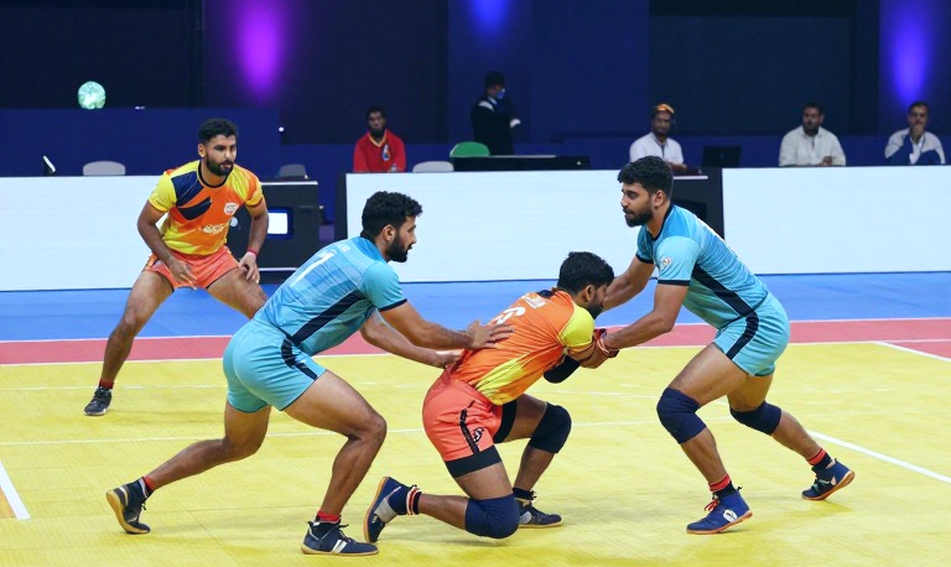
Start with the field. India beat England 46-26, Uganda 44-30 and Malaysia 37-23. All three wins came by margins of 14 to 20 points. In ordinary kabaddi, that counts as a comfortable win, but when the same tournament produces scores like England's 68-18 over Nigeria and Tanzania's 66-17 over Nigeria, India's margins look relatively modest. This is why some fans are disappointed that India did not win by a bigger margin.
One technical point matters here. Kabaddi has the 'All Out' rule. When every player on the opposing team is ruled out, the other side gets two bonus points and all the opposing players return to the mat. Once one side gains an upper hand, this rule makes the score gap widen very quickly. In kabaddi, the margin of victory is amplified by this rule, not driven only by the talent gap. The 49-50 point margins against Nigeria can be explained as the result of this situation.
India's real strength was visible not against Nigeria but in the first match against England. England scored 68 against Nigeria but could manage only 26 against India, meaning India's defense limited England's raiding by roughly 42 points. This is the strongest defensive signal of the tournament. Captain Surjeet Singh is the only clearly identified figure on this team, but the source does not state whether he is a raider, defender or all-rounder.
On the other hand, there is a concern. India conceded 23 to 30 points in three matches. For a team with a strong defense, that is a slightly loose sign. India's defense is 'good enough to win' but did not look 'airtight.' There is no direct evidence on whether India's attack depends on a single raider, because player-wise data is not provided. This is a data gap, not a clean bill of health.
Now the structure of the competition. This is an event with 'Commonwealth' branding, but kabaddi is not part of the Commonwealth Games. Its prestige sits below the Asian Games and the Kabaddi World Cup. The biggest reason is Iran's absence. Iran is the team that has challenged India at the global level, for example by winning men's gold at the 2026 Asian Games. Iran is not a Commonwealth member, so it cannot take part. This means India's three straight wins are against tier-two and tier-three teams and somewhat magnify India's strength.
The tournament format appears to be split into three tiers. India is tier one. England, Tanzania, Malaysia and Uganda are tier two. Nigeria is tier three. The roughly 49-50 point margin against Nigeria shows that team is still developing. Wins by England and Tanzania make clear that kabaddi in African countries is still at an early stage. The absence of teams with deep kabaddi traditions such as Pakistan and Bangladesh also weakens the field, though the source lists only six teams, so this cannot be stated with certainty.
The cultural and regional side also deserves attention. In India, kabaddi is a popular sport that has gained professional platforms like the Pro Kabaddi League. It is linked to rural akhada traditions and government-job pathways. Kabaddi is considered India's most-watched sport after cricket. On the other hand, participation by teams like Nigeria, Tanzania and Uganda signals outreach, not competitive depth. England's team also appears to rely mainly on the South Asian diaspora.
The 'Commonwealth' name here is part of soft power. It presents kabaddi as a shared sport of Anglophone countries. Through this, India wants to show kabaddi as a cultural export. But the reality is that kabaddi's internationalization is broad but not deep. Many flags are on the field, but very few teams are competitive. Without Iran and South Korea, this event also does not strengthen kabaddi's Olympic case.
On the commercial side, this tournament is not a platform like the Pro Kabaddi League. Its distribution appears to rely mainly on streaming, since the available material is in the form of a 'live streaming and telecast guide.' This suggests the broadcast-rights tier is below the Pro Kabaddi League or the Asian Games. Data on sponsorship, player salaries or auctions is not available, so no judgment can be made on that front. This is an international team event, and Pro Kabaddi League-style franchise auctions do not apply.
At the organizational level, lack of transparency is the biggest concern. The source does not make clear who sanctions the event or whether it has International Kabaddi Federation recognition. 'Commonwealth' branding may be used to inflate prestige, while kabaddi is not part of the Commonwealth Games. Kabaddi has a history of parallel federations and disputed events, so caution is warranted. Information on refereeing and video review is also absent.
The fourth-day match against Nigeria is one-sided on paper. Nigeria has already lost by 49-50 points, so India being the heavy favorite is natural. But for an analyst, the question is how big India's margin is and how sharp its attack looks. The real test will be against England, the only team to post a big score in this field.
Overall, three wins are a good start for India, but they should not be read as global dominance. Iran's absence, the weak performance of tier-three teams and the lack of deep opponents limit the competitive quality of this event. India's defense is sending strong signals, especially against England, but conceding 23-30 points per match means precise conclusions are difficult without player-level data. In that sense, this championship is better seen not as proof of India's dominance but as a document of kabaddi's broad expansion alongside one-sided competition.
संबंधित खिलाड़ी
अनुशंसित
India's First Match in Ahmedabad, but the Biggest Question in the Notebook Isn't England2026-10-24
Kabaddi Is Drifting Toward the Bonus Line: What 4,127 Coded Raids Showed That the Highlight Reel Couldn't2026-10-25
One Name Struck Off the Ahmedabad List: Pakistan's Withdrawal Leaves Kabaddi's Real Question in the Format, Not the Politics2026-10-23
India vs England, Match 4: What the Scoreboard Will Show, and What the Team Sheet Already Says2026-10-24
India vs England, Match 4: The Ahmedabad Mat Where the Scoreline Will Explain Nothing2026-10-24
Commonwealth Kabaddi Championship 2026: Nine Days, 13 Nations, and an Empty 'List of All Teams'2026-10-23
Surjeet Singh Captain, Naveen Kumar Deputy: What the Commonwealth Kabaddi Championship Announcement Never Says2026-10-24
अनुशंसित
India vs England, Match 4: The Ahmedabad Mat Where the Scoreline Will Explain Nothing2026-10-24
First Commonwealth Kabaddi Championship in Ahmedabad: The Number Buried Inside 62 Matches That Tells the 2030 Story2026-10-23
Surjeet Singh Captain, Naveen Kumar Deputy: What the Commonwealth Kabaddi Championship Announcement Never Says2026-10-24
The Dubki Archive: From 369 Raid Points to Jakarta, Uncovering the Change We Called Mourning2026-10-25
India vs England, Commonwealth Kabaddi Championship 2026: Rotation, a Hollow Field and a Scoreline That Won’t Tell the Truth2026-10-24
Commonwealth Kabaddi Championship 2026: India's Winning Streak, Iran's Absence, and the Expectation of a Big Win Against Nigeria2026-10-27
Kabaddi Is Drifting Toward the Bonus Line: What 4,127 Coded Raids Showed That the Highlight Reel Couldn't2026-10-25