
ATP Roundup: Alex de Minaur Survives Scare in Vienna, Ruud and Rune Also Battle Through
वियना ओपन में अलेक्स डी मिनौर ने पहला सेट 1-6 से हारने के बाद वापसी करते हुए टॉमस माचाक को 1-6, 6-4, 6-3 से हराया। कैस्पर रूड ने डोमिनिक स्ट्रिकर को हराया, जबकि होल्गर रूने ने क्वेंटिन हैलीस के 32 एसेस के बावजूद जीत दर्ज की। एटीपी फाइनल्स की दौड़ में ये जीत महत्वपूर्ण हैं।
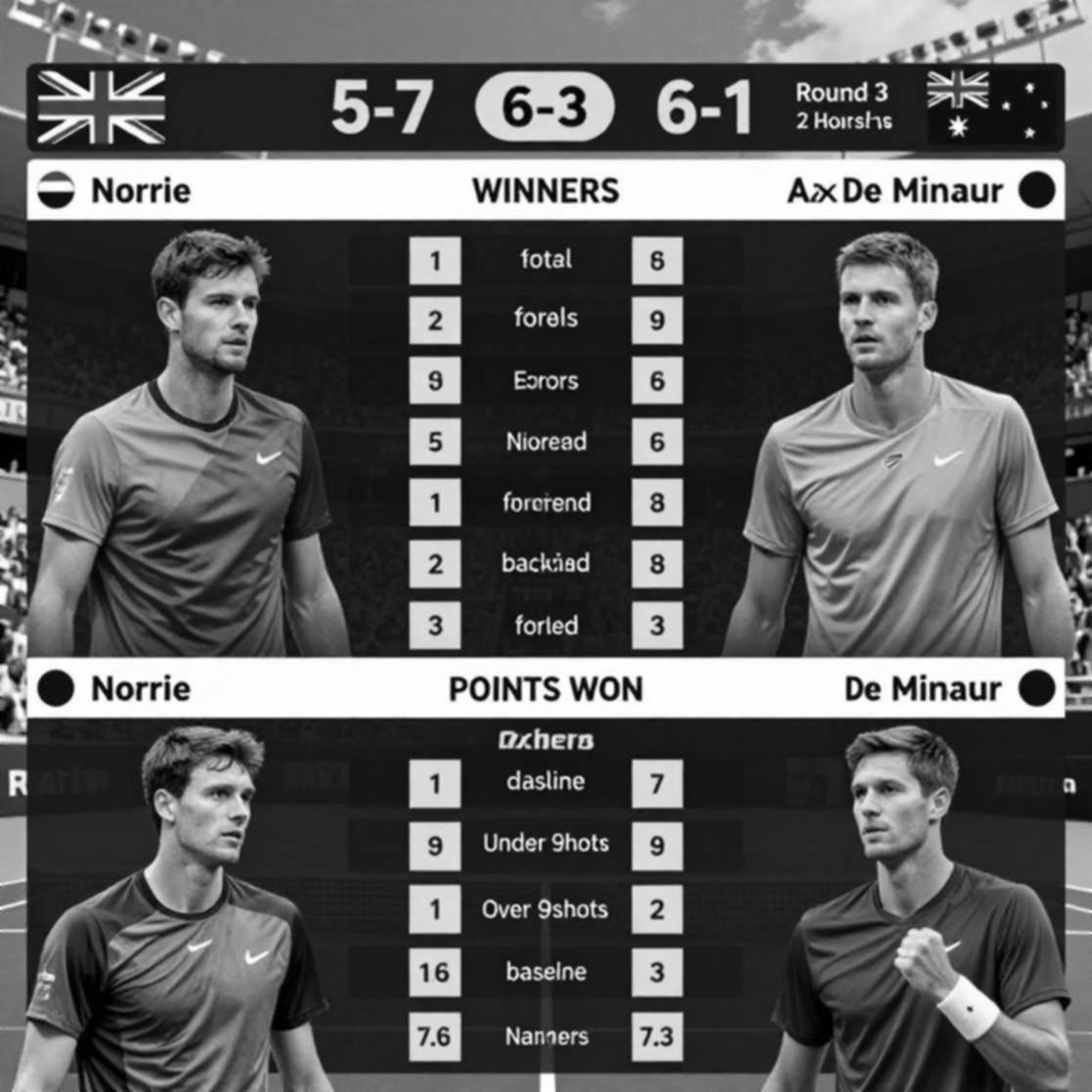
The European indoor hard court circuit is at its peak in late October. Prestigious ATP 500 tournaments like the Erste Bank Open in Vienna and the Swiss Indoors in Basel are running concurrently, and their significance goes beyond just titles. These events play a decisive role in the race to qualify for the Nitto ATP Finals at the end of the season. Every match, every set, and every break point can make a difference in the ATP Race. When top players face lower-ranked opponents in the first round, the pressure is natural. A prime example of this pressure was seen in Vienna, where world No. 10 Alex de Minaur suffered a crushing defeat in the first set against Tomas Machac of the Czech Republic. However, de Minaur turned the match around with his experience and tactical changes, winning 1-6, 6-4, 6-3. This victory was not just a match win, but crucial for staying alive in the ATP Finals race.
De Minaur's Comeback: A Classic Counterpuncher's Tale
The match began like a nightmare for de Minaur. He lost the first set 1-6. On indoor hard courts, where the ball comes fast and with low bounce, Machac's flat and aggressive baseline hitting prevented de Minaur from finding rhythm. Machac's style is that of a first-strike aggressive baseliner, who attacks immediately after the serve and doesn't allow the opponent into the rally. De Minaur, fundamentally a counterpuncher known for his speed and return, completely lost control in the first set. His serve, never his strongest weapon, becomes even more punishable in indoor conditions. Machac took full advantage of this weakness.
But from the second set, de Minaur changed his strategy. He adjusted his return position, perhaps stepping further inside, and focused on extending rally length. He also tried to disrupt Machac's flat hitting rhythm by varying slice and height. This change gradually worked. In the second set, de Minaur was trailing 4-2, but he won four consecutive games to take the set 6-4. This comeback completely changed the match's momentum. In the third and decisive set, de Minaur broke three times to win 6-3. This illustrates how a counterpuncher gradually solves a first-strike player—not by increasing serve power, but through return depth, rally length, and patience.
However, caution is needed regarding this win. It is only a single match sample. De Minaur's serve remains a structural ceiling on indoor hard courts. Analysts believe that if he faces a player who can easily attack his serve, he may struggle more. But in this match, his adaptation and mental resilience were commendable. De Minaur didn't give up after losing the first set and maintained constant pressure. This also indicates his clutch-point skills, though a single match cannot establish it as a permanent trait.
Ruud vs Stricker: Stats Don't Lie, But Results Say Otherwise
The most analytically valuable match in this roundup was between Casper Ruud and Dominic Stricker. Beyond the scoreline, Stricker led in every statistical category. He hit 13 aces to Ruud's 12, led in winners 37 to 29, and made fewer unforced errors, 18 to 26. That is, Stricker dominated his service games and played more aggressive shots, yet still lost the match. This is a classic tennis example where aggregate stats (aces, winners, UEs) do not predict break-level outcomes. The real difference was that Ruud saved his service games under pressure and Stricker failed to convert break points.
The report does not state how many break points Stricker earned or saved, but in the last two sets, Ruud did not allow Stricker a single break. This means Ruud's return game and break-point defense were strong. Stricker's problem was that he maintained serve and strike volume but failed to break Ruud's serve. This is a common trap on indoor courts—where serve power keeps you in the match, but without break conversion, you cannot win. Stricker's performance suggests his return game and break-point conversion are weak, hidden by his ranking. On the other hand, for Ruud, this win was result-based, not process-based. Such wins are not sustainable on indoor hard courts over the long term, but the ability to save serves under pressure is a real skill.
Rune vs Halys: 32 Aces Yet Defeat
The match between Holger Rune and Quentin Halys was full of excitement. Halys hit 32 aces in three sets, an extraordinary number. Normally, a player hitting 32 aces on indoor hard courts should not lose a three-set match. But Halys lost 6-4, 6-7(2), 7-6(5). This means his serve was excellent, but his return game and tiebreak shot selection or mental toughness were lacking. Rune took advantage and won a tight match. Rune's performances have been volatile, but his resilience shows in such matches. He doesn't panic under pressure and plays aggressively on big points. For Halys, the lesson is that you cannot win matches on serve alone; break-point conversion and return game must also be strengthened.
Mensik's Quick Win
Jakub Mensik defeated Lukas Neumayer 6-2, 6-2 in just 63 minutes. This was the most efficient performance in the roundup. Mensik's serve-plus-first-strike style was highly effective on the indoor court. He held his service games solidly and showed aggression on return. Neumayer, a home wild card ranked much lower, could not cope with Mensik's speed and precision. This win signals Mensik's form and confidence, especially at the end of the season.
Other Matches
Additionally, many other players took to the courts in Vienna and Basel. Names include Learner Tien, Luca Van Assche, Matteo Berrettini, Luciano Darderi, Arthur Fery, Jacob Fearnley, Daniel Altmaier, Juan Manuel Cerundolo, Nuno Borges, and Valentin Vacherot. Although detailed results of their matches are not provided in this report, it is clear that competition is fierce and every player is out to collect points in the ATP Race. Learner Tien is a young American talent, Luca Van Assche is a rising French star, Matteo Berrettini is a former top-10 player returning from injury, and Luciano Darderi is an Italian clay-court specialist trying to adapt indoors. Arthur Fery and Jacob Fearnley are British hopes, Daniel Altmaier is an experienced German player, Juan Manuel Cerundolo is an Argentine clay-courter, Nuno Borges represents Portugal, and Valentin Vacherot is from Monaco. For all of them, this tournament is an opportunity to improve ranking and form.
Form and Ranking Analysis
Looking at de Minaur's situation, he is currently world No. 10 and seeded fifth in Vienna. His ranking is based on consistent deep runs at 500-level events and hard-court Grand Slams. But does this ranking reflect his true level? Analysts believe it is mixed. On one hand, he consistently reaches deep rounds; on the other, his serve is not top-5 level. His struggle against an unseeded player in the first round indicates his ranking is at the lower edge of genuine top-10 level. He needs more consistency to stay in the ATP Finals race.
Casper Ruud's situation is the opposite. He is winning matches without process support. His stats against Stricker were poor, yet he won. This is a sign of result over process. Such wins are not sustainable on indoor hard courts over a long season. However, the ability to save serves under pressure can win him some matches. Ruud's historical performance on indoor hard courts has not suited his baseline style, so don't read too much into this win.
Holger Rune's situation is volatile but resilient. He plays brilliantly at times, ordinary at others. But winning after facing 32 aces against Halys demonstrates his mental toughness and aggression on big points. This season has been up-and-down for Rune, but if he maintains this resilience, he could be dangerous at the ATP Finals.
The ATP Finals Race
After Vienna and Basel comes the Paris Masters and then the ATP Finals in Turin. This three-week window is decisive for the ATP Race. For players like de Minaur, who are in the lower half of the top 10, every win matters. A first-round loss could have had a heavy negative impact, but he avoided it. Now he needs to collect more points in the next rounds. Ruud and Rune also want to stay in the race, and their wins have kept them alive. To secure a place in the ATP Finals, players must perform consistently, as the points gap is very small.
Technical and Tactical Conclusions
The biggest characteristic of indoor hard courts is fast speed and low bounce. Players with quality serves, return reflexes, and a low center of gravity are more successful here. Counterpunchers like de Minaur struggle initially but adapt with experience. Flat hitters like Machac dominate early but their consistency can weaken if dragged into long rallies. The Ruud vs Stricker match proved that aces and winners alone don't win matches; break-point conversion and return game play a decisive role. Halys's 32 aces and loss proved that a serve-dominant game only works if there is some substance in the return game.
Risks and Limitations
This report has some limitations. The biggest is that the original article did not provide first-serve percentage, break-point conversion rate, or return points won. Therefore, no percentage-based assessment of any player's performance can be made. Second, Ruud's good performance on indoor hard courts is contrary to his normal profile, so treat it as an outlier. Third, de Minaur's serve will always be attackable in indoor conditions. Fourth, surface specialization bias should be avoided. Permanent traits or flaws of a player should not be judged on the basis of one match.
Conclusion
These matches in Vienna and Basel show how much every win matters for top players at the end of the season. De Minaur overcame a tough match to show he is a serious contender in the ATP Finals race. Ruud and Rune also won, but there is room for improvement in their performances. Mensik's quick win signals his bright future. In the coming weeks at the Paris Masters and ATP Finals, the picture will become clearer as to who secures a place in Turin. For now, it is an exciting time for tennis fans, where every match can change the race equation.
संबंधित खिलाड़ी
अनुशंसित
Manchester City 5-1: A Big Win, A Small Sample — And The Transfer Window Is Already Selling It2026-10-24
The Ledger of City's 5-1: Foden's Three Goals, AEK's One Shot, and a Report That Named the Wrong Coach2026-10-23
The 6-4 in Ningbo: Kostyuk's Retirement, Muchova's Last Seat, and the Week Nobody Audits2026-10-23
How Svitolina Told Monfils About the Divorce: Three Ledgers Inside a Private Story2026-10-23
Ningbo Final: Rybakina's Title Saves 500 Points, Adds None2026-10-25
Swiatek's Season Stops Early: The Thigh, the No. 9 Ranking, and a Bet on the 2027 Australian Open2026-10-23
The Empty Court of 20 October: The Date Tennis Left Behind, and Pickleball Wore2026-10-23
अनुशंसित
The Ledger of City's 5-1: Foden's Three Goals, AEK's One Shot, and a Report That Named the Wrong Coach2026-10-23
The File Said Tennis. Inside Were Truck Tyres.2026-10-23
How Svitolina Told Monfils About the Divorce: Three Ledgers Inside a Private Story2026-10-23
ATP Roundup: Alex de Minaur Survives Scare in Vienna, Ruud and Rune Also Battle Through2026-10-28
Ningbo Final: Rybakina's Title Saves 500 Points, Adds None2026-10-25
Manchester City 5-1: A Big Win, A Small Sample — And The Transfer Window Is Already Selling It2026-10-24
Shnaider's Ningbo Win: A Ten-Break Match That 7-5, 6-4 Cannot Hide2026-10-23